
The Secret Language of Symbols: The Peacock

Some symbols arrive quietly, like a feather found on a path.
The peacock is not one of them.
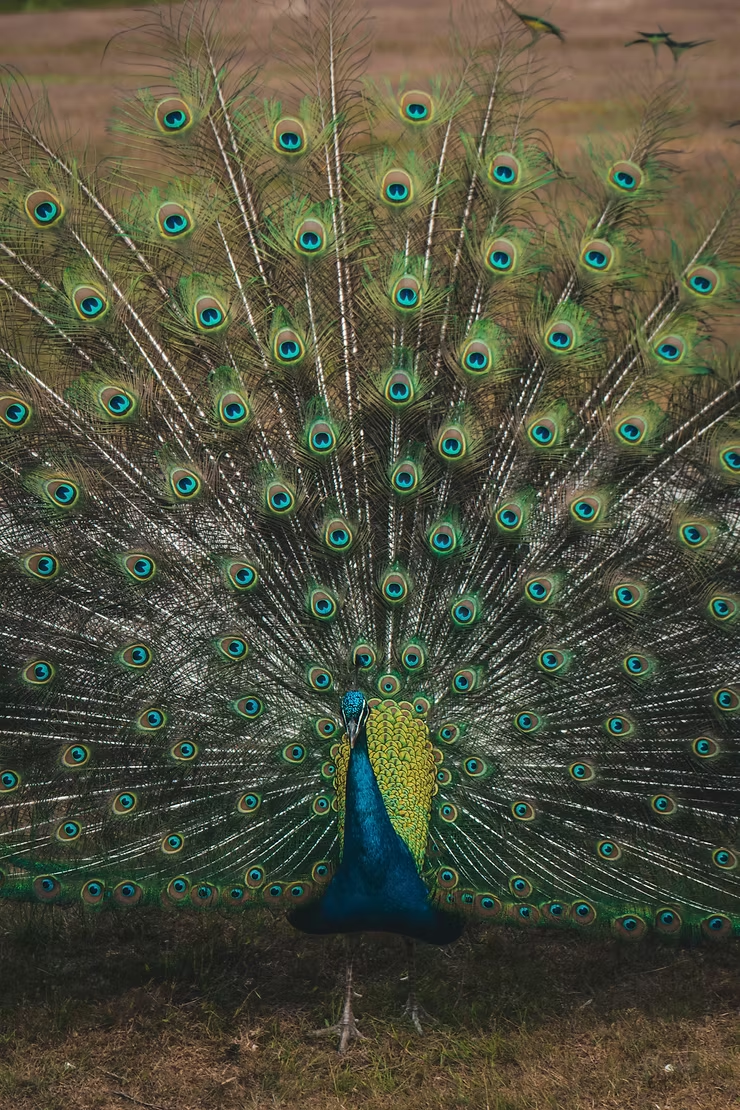
The peacock enters like an opera singer in full costume, having apparently missed the memo about humility. It does not sidle into the symbolic imagination. It fans itself open. It shimmers. It says, in no uncertain terms: look at me.
And that, of course, is where the trouble begins.
Because many of us are deeply uneasy about being seen.
We are taught, often very early, not to show off, not to take up too much space, not to be “too much”. We learn to tuck our brightness away. We trim our colours to fit the room. We become experts in being acceptable, useful, and manageable.
Then along comes the peacock, dragging behind it a fan of blue, green and gold, asking: What if your beauty was not a problem?
At one level, the peacock is a symbol of display. It is associated with vanity, pride and self-importance. To “peacock” is to show oneself off, usually with a touch too much confidence and perhaps a jacket no one asked for. We all know that version. The inflated self. The person who cannot quite leave a room without making sure everyone has noticed their departure.
But symbols are rarely so simple.
The peacock also carries a deeper message about visibility. Its magnificent tail is not merely a decoration. It is a revelation. It shows what has been hidden. It fans out the inner world into colour and pattern.
In dreams, myths and inner life, the peacock may appear when something in us is ready to be seen. Not the polished persona, not the performance, but the deeper radiance of the self. The part of us that has survived shame, comparison, criticism and the long, grey education in self-doubt.
There is also something extraordinary about the “eyes” in the peacock’s feathers. They seem to look back at us. In symbolic language, eyes often suggest awareness, perception and consciousness. The peacock may therefore speak not only of being seen by others, but of seeing ourselves more fully.
This is not always comfortable.
To truly see ourselves is not simply to admire the attractive parts. It is to recognise the whole pattern. The beauty and the awkwardness. The longing to shine and the fear of being judged. The genuine gift and the temptation to use that gift for applause. The peacock asks us to notice where healthy self-expression ends, and performance begins.
In this sense, it is a surprisingly useful therapeutic symbol.
Many people arrive in therapy with their colours faded. They may not describe it that way, of course. They might say they feel flat, anxious, invisible, stuck, or strangely disconnected from themselves. But somewhere, often hidden beneath years of adaptation, there is a lost brightness—a way of moving, speaking, creating or loving that has been subdued for too long.
The peacock reminds us that healing is not only about reducing distress. It is also about recovering vitality.
There is an old spiritual association between the peacock and transformation. In some traditions, it is linked with immortality and renewal, partly because of the way its feathers are shed and regrown. Symbolically, this gives us another layer. The peacock does not merely dazzle. It renews its splendour. It knows how to lose and regrow.
That feels important.
Because the beauty we recover in later life is often not innocent. It is not the untouched brightness of childhood. It is something more weathered, more truthful. It has passed through grief, disappointment, embarrassment, ageing, loss and the occasional deeply unflattering photograph. It is not perfect. It is alive.
And perhaps that is the real teaching of the peacock.
Not vanity, but permission.
Permission to unfold a little more.Permission to stop apologising for the colour in us.Permission to be visible without becoming inflated.Permission to recognise that modesty, when overdone, can become another hiding place.
Of course, there is a balance. The peacock can warn us against empty display. It can ask where we are performing rather than expressing, seducing rather than relating, dazzling rather than connecting. But it can also challenge the opposing wound: the belief that we must remain small to be loved.
So, if a peacock appears in a dream, an image, a sudden fascination, or even on a cushion you find yourself oddly drawn to in a shop, it may be worth asking:
Where am I hiding my colours?
Where am I afraid to be seen?
What part of me longs to unfold?
And where might I be confusing visibility with vanity?
The peacock is a flamboyant teacher, admittedly. Not everyone’s preferred guide. Some of us might prefer a wise old owl or a discreet little robin. But symbols do not always arrive in the outfit we would choose for them.
Sometimes the psyche sends a peacock.
And when it does, it may invite us to stand a little more openly in our own lives. Not to strut, necessarily. Though on a good day, why not? But to remember that the soul, when allowed its full expression, is rarely beige.
As I explore in The Seeds of Change: How Therapists Cultivate Personal Growth, healing often begins when something hidden finds a form: a word, an image, a gesture, a dream, a symbol. The peacock, with all its impossible colour and beauty, reminds us that what has been folded away may not be lost.
It may simply be waiting for the right moment to open.


Comments